The Cardinals finished just 3-14 last season, moving on from Kyler Murray and turning to Jacoby Brissett to lead the offense down the stretch. Despite the disappointing record, the season ended on a somewhat encouraging note, with Michael Wilson and Trey McBride both finishing strongly and providing some optimism for the future of the offense. Unfortunately, much of that optimism has faded throughout the offseason. Arizona’s offseason has been overshadowed by a contract dispute involving Brissett, and there has been little positive momentum surrounding the team.
Mike LaFleur arrives as an intriguing first-time head coach after serving under Sean McVay with the Rams. LaFleur brings the familiar Shanahan-McVay offensive system and inherits a solid collection of offensive weapons to work with. Nathaniel Hackett joins the staff as offensive coordinator, and the two will be tasked with piecing together an offense capable of taking a step forward in 2026.
On the defensive side, Nick Rallis returns for his fourth season as defensive coordinator. He continues to run a 3-4 scheme but enters the year facing increased pressure after his defenses have often lagged behind the offense during his tenure in Arizona. General manager Monti Ossenfort clearly still believes in Rallis, as he is the lone holdover from the previous coaching staff following the hiring of Michael Ghobrial from the Giants to oversee special teams.
Quarterbacks (31st)

The quarterback situation in Arizona is far from a strength, and it becomes even more concerning with the ongoing contract dispute surrounding Jacoby Brissett. Brissett is one of the league’s better backup quarterbacks, but as a starter, his ceiling is fairly limited. He proved last season that he can generate production for the weapons around him, helping players like Michael Wilson and Trey McBride put up impressive numbers, but that production did not translate into wins. Brissett won’t sink a team, but he is unlikely to elevate one either. With Brissett’s holdout creating uncertainty, the depth behind him comes under greater scrutiny. Gardner Minshew is another quality veteran backup who could likely keep the offense operating at a similar level, though he tends to be more aggressive and, as a result, more prone to mistakes.
The most intriguing quarterback in the room is third-round pick Carson Beck. Even with the late momentum he generated during the draft process, I was not a fan of the selection. I view Beck’s ceiling as that of a quality NFL backup, which is not the type of upside Arizona should be targeting in a quarterback prospect while already carrying experienced veterans like Brissett and Minshew. I would have preferred to see the Cardinals take a swing on a higher-ceiling prospect, but if Beck is forced into action, he should at least provide competent play.
Kedon Slovis rounds out the quarterback room. Once a highly touted college player, he has yet to establish himself at the NFL level and will likely be competing for a practice squad spot. If Brissett returns and starts the full season, this quarterback room probably finishes higher than 31st in the league rankings, but the uncertainty surrounding the position pushes it down a few spots.
Running Backs (10th)

Running back was a disaster for the Cardinals last season, though not because of a lack of talent. Both starter James Conner and backup Trey Benson suffered season-ending injuries early in the year, forcing Arizona to rely on a committee of Michael Carter, Emari Demercado, and Bam Knight. That trio was unable to provide the consistency the Cardinals needed on the ground, and the running game struggled throughout the season.
Arizona made sure to address that problem aggressively this offseason. Most notably, the Cardinals used the third overall pick on Jeremiyah Love, making him one of the highest-paid running backs in the league before ever taking an NFL snap. Love is a true three-down prospect with the ability to impact the game as both a runner and receiver. Despite his elite talent, he enters the league with less wear and tear than many top prospects thanks to sharing carries with Jadarian Price at Notre Dame. He is expected to take over as the lead back immediately.
Love’s arrival creates an interesting situation for new addition Tyler Allgeier. Allgeier enjoyed a strong rookie season in Atlanta before eventually settling into a backup role behind Bijan Robinson. When he reached free agency, he likely envisioned an opportunity to return to a featured role, but that path disappeared when Arizona drafted Love. Still, Allgeier remains one of the league’s better complementary power backs and should continue to thrive in that role.
James Conner was a somewhat surprising re-signing given his age and the injury that ended his 2025 season. While he may have lost a step, he should still provide productive depth and valuable veteran leadership. Meanwhile, 2024 third-round pick Trey Benson remains on the roster, though he now finds himself buried on the depth chart as the fourth running back. That makes him one of the more obvious trade candidates at the position around the league.
Bam Knight, who played a significant role last season, is still in the mix and would likely secure a roster spot if Benson is moved. Corey Kiner rounds out the group. He was one of my favorite undrafted free agents in the 2025 class, and I’d still like to see him get an opportunity somewhere, but with the Cardinals’ backfield now crowded with talent, that opportunity is unlikely to come in Arizona.
Weapons (19th)
Wide Receivers (28th)

The Cardinals’ top two receivers are recognizable names with significant upside, but both remain unproven enough to make this a difficult position group to rank. Marvin Harrison Jr. entered the league as one of the most highly touted non-quarterback prospects in recent memory, yet he has not fully lived up to those expectations through his first two seasons. He remains the clear WR1 on paper, but he still has plenty to prove before he can be considered one of the league’s elite receivers.
Michael Wilson may have been Arizona’s most pleasant surprise last season. After a relatively quiet start to his career, he broke out in a major way and emerged as a legitimate playmaker. That said, Wilson’s résumé still consists of roughly half a season of high-level production, making it difficult to project him among the league’s top receiving options just yet.
Kendrick Bourne provides a valuable veteran presence and helps stabilize a room filled with uncertainty. His reliability and versatility make him a strong complementary piece alongside the Cardinals’ more volatile top options. However, he is ideally suited for a WR4 or WR5 role rather than a full-time starting position.
Beyond the top three, Arizona lacks proven production. Devin Duvernay is the likely WR4, but his primary value comes on special teams as a return specialist rather than as a major contributor on offense. Reggie Virgil, a fifth-round rookie, enters the season without significant expectations and will likely be given time to develop.
Simi Fehoko, meanwhile, has generated considerable buzz during minicamp after struggling to stick on NFL rosters in previous seasons and is currently projected to earn a spot on the 53-man roster. The competition for the final receiver spots remains wide open though. Xavier Weaver, an undrafted free agent from the 2024 class, has spent time with the organization and could push for a roster spot. Jalen Brooks and 2024 sixth-round pick Tejhaun Palmer both offer intriguing developmental upside as well. Ihmir Smith-Marsette, Bryson Green, and Harrison Wallace III round out the group. Of those names, Wallace is the most intriguing long-term prospect, but as an undrafted rookie, he appears more likely to begin his career on the practice squad than on the active roster.
Tight Ends (3rd)

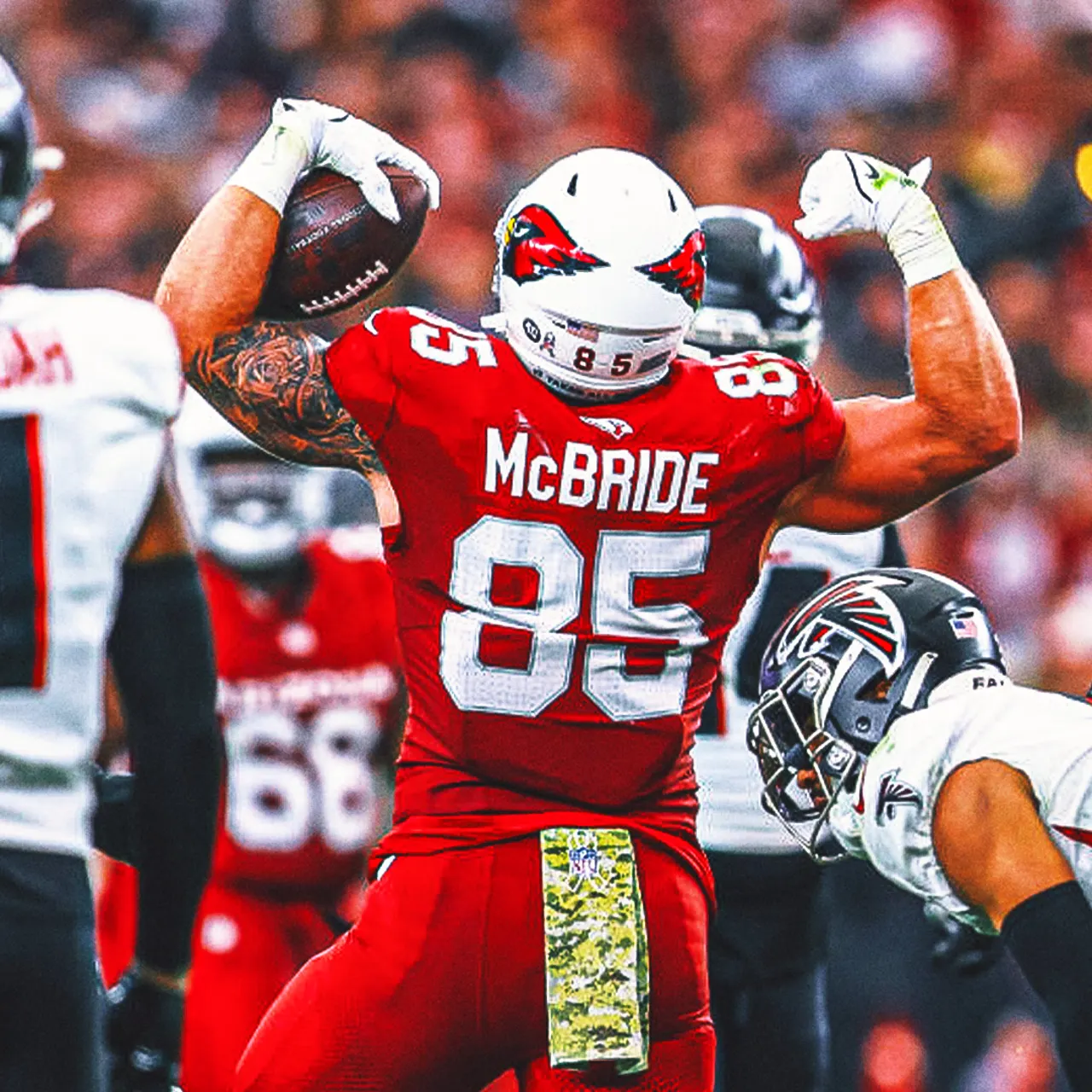
Trey McBride has developed into one of the league’s premier tight ends and single-handedly elevates both this position group and the Cardinals’ offense as a whole. His impact in the passing game takes pressure off Marvin Harrison Jr. and Michael Wilson on the outside while providing whichever quarterback wins the job with a reliable, high-level target. McBride’s presence gives Arizona a legitimate offensive centerpiece and raises the ceiling of the entire unit.
Behind him, Tip Reiman serves as a blocking specialist. Through two seasons, he has recorded just nine receptions for 55 yards, with most of his value coming as an extra blocker in the run game. Elijah Higgins operates as the third tight end and offers a very different skill set. A former wide receiver, Higgins brings more receiving upside and athleticism than Reiman. While both players are somewhat one-dimensional, their contrasting strengths combine to give Arizona a quality backup tight end duo.
Recent addition Kenny Yeboah has generated some buzz and could earn a roster spot thanks to his special teams value. Personally, I would like to see Teagan Quitoriano make the roster. Unlike Reiman and Higgins, who each fill highly specialized roles, Quitoriano profiles as a more traditional all-around tight end in the mold of McBride, giving the room a different type of depth option.
Rivaldo Fairweather and Jameson Geers round out the position group. Neither player was drafted, and neither is currently expected to make the 53-man roster. Of the two, Geers is the name I’ll be watching most closely. I followed him during the draft process and am interested to see whether he can do enough to stick around in Arizona, even if it is initially on the practice squad.
Offensive Line (22nd)
Offensive Tackles (23rd) & Interior Offensive Line (16th)
The Cardinals’ offensive line remains a work in progress. The cornerstone of the unit is Paris Johnson Jr., the sixth overall pick in the 2023 draft. While he hasn’t quite developed into one of the truly elite Tackles many envisioned when he entered the league, he has still become a quality starter and one of the strengths of both this offensive line and the roster as a whole.
At center, Hjalte Froholdt returns for his fourth season in Arizona after establishing himself as a reliable starter. The Cardinals also added veteran guard Isaac Seumalo in free agency, giving the interior another proven player and helping raise the overall floor of the unit.
The biggest question on the interior is at right guard, where second-round rookie Chase Bisontis is expected to compete with 2024 third-round pick Isaiah Adams. Adams struggled during his first season as a starter, so Arizona will be hoping Bisontis can seize the job quickly. If Adams wins the competition, it may say more about Bisontis’ readiness than it does about Adams’ development.
The other major concern comes at right tackle. That spot is expected to be filled by one of Arizona’s free-agent additions, Elijah Wilkinson or Oli Udoh. Wilkinson currently appears to have the edge, but both players profile more as quality swing tackles than long-term starters. Regardless of who wins the job, the position projects as the weakest point on the offensive line. Combined with the uncertainty at right guard, the entire right side of the line could become a significant liability in 2026.
The depth behind the starters is also unsettled. Josh Fryar, an undrafted free agent from the 2025 class, is currently the next tackle off the bench after seeing action last season and enduring the expected growing pains. Christian Jones, a 2024 fifth-round pick, and rookie seventh-rounder Jayden Williams are both fighting to make the roster despite being recent draft selections. Veteran Demontrey Jacobs faces an uphill battle as well, while Valentin Senn remains a developmental project through the International Player Pathway Program.
On the interior, Jon Gaines II is the favorite to secure the final roster spot, with Hayden Conner, Matt Pryor, and undrafted rookie Ka’ena De Cambra competing for depth roles. Overall, this offensive line has enough quality pieces to avoid being a major weakness, but there are simply too many questions to rank it among the league’s better units. The Cardinals come in at 22nd in my rankings, though there is room for improvement if Bisontis develops quickly and solidifies the right side of the line.
Offense (30th) – Pass Game (30th) – Run Game (17th)
The Cardinals’ offense doesn’t grade out nearly as poorly as its overall ranking might suggest. Outside of the quarterback room, there are solid pieces in place at nearly every position. Unfortunately, quarterback is the one position capable of dragging down an entire offense, and that’s exactly what happens here. The uncertainty surrounding the position leaves Arizona with my 30th-ranked offense entering the season.
That said, there is still plenty of talent to be excited about. The Cardinals have assembled a strong supporting cast that should provide a solid foundation for the franchise’s next long-term answer at quarterback, whether that ends up being Carson Beck or someone who is not currently on the roster.
As for 2026, I expect the offense to lean heavily on its strengths. Jeremiyah Love should make an immediate impact and help power an improved rushing attack, while Trey McBride is once again positioned to be the focal point of the passing game. Even if the quarterback situation limits the offense’s overall ceiling, there is enough talent here for several skill-position players to put together highly productive seasons.
Defensive Line (28th)
Interior Defensive Line (27th)

The Cardinals’ interior defensive line does not rank particularly high entering the season, but it is a unit with plenty of upside. The centerpiece of the group is 2025 first-round pick Walter Nolen III, who put together a strong rookie campaign and now projects as the top interior defender on the roster. Nolen has the talent to eventually develop into one of the league’s premier interior linemen, but for now he remains a quality starter rather than a proven star.
Lining up alongside him is 2024 first-round pick Darius Robinson. Unlike Nolen, Robinson has struggled to establish himself at the NFL level and is not currently playing at a starting-caliber standard. His draft pedigree and physical tools have earned him continued opportunities, but entering his third season, the margin for error is shrinking. At some point, potential has to translate into production.
Roy Lopez rounds out the starting trio at nose tackle. Lopez is a steady veteran who does his job effectively, even if he is unlikely to make many game-changing plays. He provides stability in the middle of the defense and helps anchor the run game.
Andrew Billings serves as the fourth lineman in the rotation, though he is also best suited for nose tackle duties. If Robinson struggles enough to lose his starting role, veterans Dante Stills or L.J. Collier would likely be the leading candidates to step into a 3-4 defensive end spot. Jonah Williams and P.J. Mustipher are also competing for depth roles and roster spots.
Fourth-round rookie Kaleb Proctor was expected to compete for playing time as part of the rotation, but a training camp injury is projected to sideline him for the entire season. Zachary Carter and undrafted rookie Damonic Williams round out the group and are currently more likely to land on the practice squad than the active roster.
Overall, this is a defensive line room with intriguing long-term potential, but too many questions remain for it to rank much higher. Nolen has not yet developed into a true No. 1 presence, while Robinson’s struggles leave a significant hole in the starting lineup. The talent is there for this group to outperform expectations, but entering the season, it checks in at just 27th in my rankings.
Edge Rushers (20th)

I like this edge group quite a bit, but the sheer number of talented edge rooms across the league prevents the Cardinals from ranking much higher. Josh Sweat remains one of the NFL’s most underrated pass rushers and is a valuable piece for any defense. On a truly elite edge unit, he would ideally serve as the No. 2 option, but in Arizona he is tasked with leading the group as the top pass-rushing threat.
Across from him, former first-round linebacker Zaven Collins has successfully transitioned into a quality 3-4 edge defender. His versatility allows Arizona to use him in a variety of ways, making him a valuable piece of the front seven. Baron Browning, another former linebacker, brings a more traditional edge-rushing skill set but has enough versatility to fill a similar role if needed. Together, Sweat, Collins, and Browning form a strong rotational trio that elevates the entire defense.
Behind the veterans are two intriguing but unproven options in B.J. Ojulari and Jordan Burch. Ojulari’s career has been derailed by a combination of injuries, inconsistent playing time, and underwhelming performance, but the Cardinals do not appear ready to move on from the former second-round pick. Burch, meanwhile, was selected in the third round just a year ago and still possesses the developmental upside that made him such an appealing prospect.
If Arizona carries an additional edge rusher, veteran Eku Leota appears to be the favorite for the role. Elliott Brown and undrafted rookie Cameron Robertson round out the group and are more likely candidates for the practice squad than the active roster.
Overall, this is a well-constructed edge room that blends proven production, versatile skill sets, and developmental upside. The Cardinals lack a true game-changing pass rusher capable of consistently taking over games, which limits the group’s ceiling compared to the league’s elite units. Even so, this is a deep and reliable rotation that should play a major role in keeping Arizona competitive on the defensive side of the ball.
Linebackers (30th)

Veteran linebacker Mack Wilson Sr. fits squarely into the category of an average NFL starter. Given how few true difference-makers exist at the position, there is value in having a reliable veteran who can handle a starting role, but Wilson is not the type of player who elevates an entire defense. He is a steady, serviceable linebacker who can hold down the position without being a major strength.
The bigger question mark comes at the other starting spot, where 2025 fourth-round pick Cody Simon appears to have the inside track. Simon struggled during his rookie season, and unless he takes a meaningful step forward in Year 2, he could become a liability in the middle of the defense. Arizona will be counting on his development to stabilize the position group.
If Simon fails to lock down the job, Jack Gibbens is the most likely alternative. While he lacks high-end athletic traits, Gibbens is an experienced veteran with a strong understanding of the position and can provide competent play when called upon. His presence gives the Cardinals a reasonable fallback option, even if he is unlikely to offer much upside.
The depth behind the top three consists primarily of developmental players. Sixth-round rookie Karson Sharar has a legitimate opportunity to make the roster and carve out a role on special teams. To do so, he may need to beat out Owen Pappoe, a 2023 developmental pick who has yet to put everything together at the NFL level. Austin Keys rounds out the group. A member of the 2025 undrafted free agent class, he has already spent time with multiple organizations and enters camp fighting for a depth role.
Cornerbacks (19th)

The Cardinals have one of the deeper and more intriguing cornerback rooms in the league, but it is also one of the more difficult groups to evaluate. Depending on how a few key questions are answered, this unit could emerge as a major strength or become a significant weakness.
Garrett Williams is likely the best cornerback on the roster, but his status comes with some uncertainty after suffering a torn Achilles in December. He is expected to play this season, though it remains to be seen whether he will miss time or return at the same level of athleticism he displayed before the injury. Williams has the versatility to play outside, but he is at his best in the slot and will likely be asked to fill that role whenever he is healthy.
The projected outside starters are second-year players Will Johnson and Denzel Burke. Johnson entered the league as a highly regarded prospect whose medical concerns contributed to his fall into the second round. If he can stay healthy, he has the talent to become a cornerstone of this secondary and is one of the biggest reasons for optimism on the defensive side of the ball. Burke, meanwhile, was a fifth-round pick who exceeded expectations as a rookie. While he still has plenty to prove, his performance last season earned him the opportunity to compete for a major role once again.
Behind those three is veteran Sean Murphy-Bunting, who provides valuable depth and insurance. Even if Williams, Johnson, and Burke all meet expectations, Murphy-Bunting should still see meaningful snaps throughout the season. Max Melton may be the most polarizing player in the room. The 2024 second-round pick has supporters who view him as a potential starter, while others question whether he is even guaranteed a roster spot. At this stage, I would explore trade options if there is interest, but I still view him as a quality cornerback with value as part of the rotation.
Starling Thomas V offers additional versatility, with the ability to play both outside and in the slot. Jaden Davis is the most natural backup slot corner on the roster, though his place on the 53-man roster is far from secure given the number of other defensive backs competing for roles. Former draft picks Elijah Jones and Kei’Trel Clark have fallen down the depth chart and face an uphill battle to survive final cuts. Kalen King and Elijah Culp round out the group as likely practice squad candidates.
Overall, this room lacks a true star cornerback, but it makes up for that with depth, versatility, and upside. The challenge is that nearly every key contributor comes with some level of uncertainty, whether due to health, inexperience, or inconsistent performance. If the coaching staff can sort through the competition and get reasonable injury luck, there is enough talent here to field a quality secondary. The difficulty is projecting exactly which players will emerge as the long-term starters, making this one of the most volatile position groups on the roster.
Safeties (9th)

Safety is the strongest position group on the Cardinals’ defense, though much of that distinction can be attributed to the presence of Budda Baker. While Baker may not generate the highlight-reel ball production that often brings national attention, he remains one of the league’s most effective safeties. His impact extends far beyond interceptions, as he consistently provides value in run support, tackling, coverage, and overall defensive communication. In fact, despite recording just one interception over the past three seasons, he continues to be one of the most productive and reliable safeties in football.
Lining up alongside Baker is expected to be former fourth-round pick Dadrion Taylor-Demerson. An explosive athlete with impressive range, Taylor-Demerson flashed playmaking ability as a rookie, recording two interceptions while flying around the field in limited opportunities. The Cardinals will be hoping he can take another step forward and establish himself as a long-term starter. If Taylor-Demerson is unable to solidify that role, veteran Andrew Wingard provides an excellent fallback option. Wingard is the ideal third safety, capable of handling responsibilities at both strong and free safety while also serving as a valuable special teams contributor. Every roster benefits from players who can seamlessly fill multiple roles, and Wingard fits that description perfectly.
Kitan Crawford also saw action as a rookie, particularly on special teams, and showed enough promise to project as a useful depth piece moving forward. His athleticism and versatility should help him maintain a roster spot while continuing to develop defensively. The recent addition of Isaiah Oliver adds another layer of competition to the room. Oliver is an intriguing veteran option who could earn a roster spot if Arizona decides to carry five safeties. His arrival complicates the outlook for Joey Blount and undrafted rookie Wydett Williams Jr., both of whom now appear more likely to compete for practice squad spots than places on the active roster.
Overall, while not a truly elite safety room from top to bottom, the Cardinals have a strong and well-rounded group led by one of the league’s premier veterans. Baker gives the Cardinals a true difference-maker on the back end, while Taylor-Demerson, Wingard, and Crawford provide quality depth and versatility. Compared to the other defensive position groups on the roster, safety stands out as Arizona’s most dependable unit entering the season.
Defense (28th) – Front Seven (28th) – Coverage Unit (24th)
As a whole, the Cardinals’ defense ranks 28th entering the season. While there are a few encouraging pieces throughout the roster, most of the individual position groups grade out below league average, creating a unit with more questions than answers. There is some legitimate upside here, particularly among the younger players, but much of it remains projection rather than proven production.
The defense does have a foundation to build upon. Budda Baker remains one of the league’s most reliable safeties, the cornerback room offers intriguing depth and developmental potential, and players such as Walter Nolen III and Will Johnson give the Cardinals reasons for optimism about the future. However, there are too many uncertain roles and too few established difference-makers for this group to rank any higher entering 2026.
If there is one area that could outperform expectations, it is the coverage unit. Between Baker, Garrett Williams, Johnson, Denzel Burke, and several other capable defensive backs, Arizona has enough talent in the secondary to surprise people if the pieces come together. The front seven is a different story. While there are some quality contributors and a handful of intriguing young players, the group still feels a player or two away from becoming a true strength. Until those missing pieces are found, it is difficult to envision this defense being the driving force behind a successful season for the Cardinals.
Specialists (19th)

The Cardinals’ special teams unit is fairly unremarkable on paper. Chad Ryland has developed into a solid and dependable kicker. The same can be said for punter Blake Gillikin, who has been a reliable presence without providing a significant advantage in the field position battle. Veteran Casey Kreiter joins the team as the new long snapper, bringing experience and stability to the operation.
The biggest strength of the unit is Devin Duvernay. One of the league’s better return specialists, Duvernay has the ability to flip field position and generate explosive plays in the return game. However, if injuries or depth concerns force him into a larger offensive role, Arizona could choose to reduce his special teams workload or share return duties with other players on the roster.
The coverage units are a greater concern. Arizona’s kick coverage group did not grade out particularly well, and there is little proven evidence that it will take a significant step forward this season. As a result, the Cardinals may find themselves relying more heavily on Duvernay’s return ability than on consistently winning the hidden-yardage battle elsewhere on special teams.
Special teams can be one of the most difficult areas of a roster to project from year to year, but entering the season, this looks like an average to slightly below-average unit. There are no glaring weaknesses among the specialists themselves, yet there are also few impact players outside of Duvernay capable of turning special teams into a true advantage for Arizona.
Win Prediction (Over 4.5)
This is my first over pick, as I have the Cardinals finishing above their 4.5-win total, though not by much. My position rankings may come across as harsher on Jacoby Brissett than I actually am. While I don’t view him as a long-term answer or a quarterback capable of elevating a roster, I do think he’s a serviceable starter who can keep an offense functional. As long as he’s on the field, he should give Arizona a chance to remain competitive in a number of games.
Even if Brissett misses time or the contract situation remains unresolved, Gardner Minshew and Carson Beck provide enough depth that the quarterback position shouldn’t completely derail the season. Neither projects as a major difference-maker, but both are capable of helping the Cardinals steal a few wins over the course of the year.
Arizona also has enough talent elsewhere on the roster to outperform expectations. Players like Trey McBride, Jeremiyah Love, Budda Baker, and Josh Sweat can impact games in meaningful ways, and the roster as a whole feels more competitive than some of the teams expected to be at the bottom of the standings.
Ultimately, this just doesn’t feel like a team that will be seriously competing for the No. 1 overall pick. I know that puts me in the minority compared to many projections, but I see a roster capable of winning five or six games. There is certainly a scenario where a slow start pushes the organization toward prioritizing the development of Beck and other young players over short-term results. Even so, I expect the Cardinals to show enough flashes early in the season to avoid a full-scale tank and finish comfortably above the league’s tanking teams.