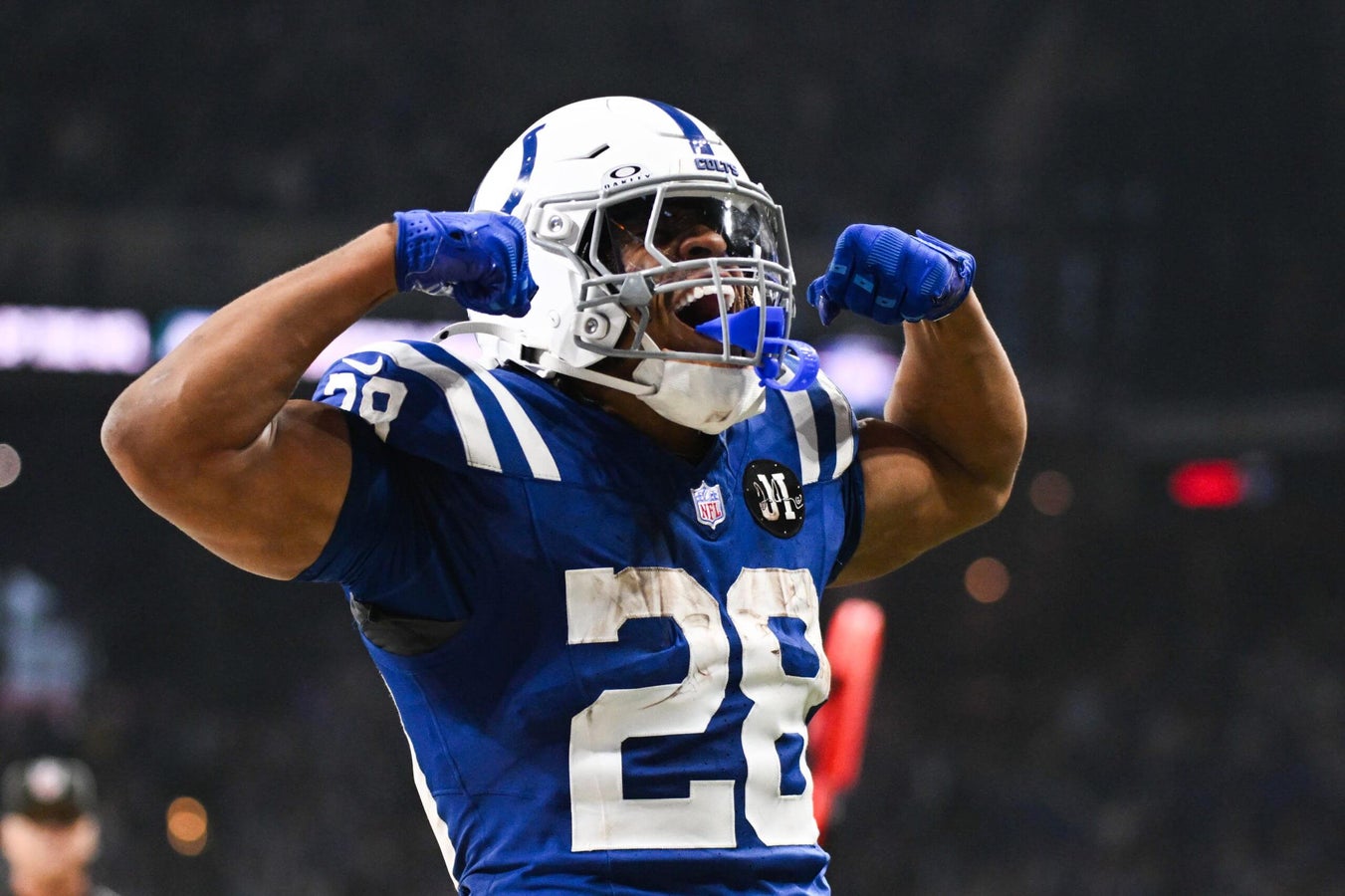
The Colts came out of nowhere to become the talk of the town halfway through last season. They made big trades at the deadline, then everything came crumbling down. The result of that breakout season was an 8-9 record, no playoffs, no first-round pick, and quarterback uncertainty once again. But at least we got the Phillip Rivers un-retirement storyline.
New owner Carlie Irsay-Gordon, who took over following the passing of Jim Irsay, used last season to evaluate the front office and coaching staff, but ultimately elected to bring everybody back, most notably head coach Shane Steichen. I believe in Steichen as an offensive mind, but simply put, he needs to learn how to win here or he’s going to get fired. Throughout his career he’s hovered around .500 regardless of the level of talent he’s had, but with a more talented roster in Indianapolis he needs to break through and at least sniff the playoffs this season. Unlike some other offensive minds who haven’t quite worked out as head coaches, I have no reason to doubt Steichen’s ability to be a leader of men either. He’s good at putting players in their best roles, letting his stars shine, and building a simpler offense for the quarterback.
Unlike a lot of offensive coordinators under an offensive head coach, Jim Bob Cooter hasn’t just followed Steichen around his entire career. The two overlapped for one season in Philadelphia, but outside of that, Cooter brings his own experiences to help shape this offense. That isn’t to say Cooter and Steichen don’t run the same style of offense. They both have most of their experience in a pro-spread system. The difference in their backgrounds simply allows Cooter to have a bit more involvement in the offense than you might expect.
Lou Anarumo is a big-name defensive coordinator after his work in Cincinnati helped lead the Bengals to a Super Bowl. His defense relies heavily on disguises and demands versatility from his players. He’s fallen off in recent years and didn’t get the most out of this Colts defense last season, but with all the injuries they dealt with, he deserves another chance to right the ship. Pretty much every defense in the NFL is built off the Fangio, McDonald, or Saleh tree, and Anarumo is one of the few coordinators who truly does his own thing. In a way, he doesn’t have a set scheme. He adapts to his personnel, opponent, and situation, but that also means his players have to be ready to do everything, making the system more demanding even if it’s effective.
Brian Mason made the jump from the college ranks and has been Indianapolis’ special teams coordinator since 2023. He’s never put together a fantastic unit or an awful one, consistently keeping the group around the middle of the pack. I will give him some credit, though. The Colts have rotated kickers quite a bit during his tenure, and he hasn’t let that become a major problem. I’m still not convinced they’ve found their specialists of the future, but Mason will have to work with what he has.
GM Chris Ballard has been here for years and has a very clear vision, at least in the draft, of betting on athleticism. That approach hasn’t exactly worked out, and it’s part of the reason he’s been on the hot seat, but the team’s 2025 resurgence bought him more time. He didn’t have much cap space to work with this offseason, so the additions were fairly limited, but the moves they made during last season have set this roster up to compete. Not to say for certain that Ballard would’ve went and made moves even if he had the space, as his regime has been known retaining talent over obtaining talent.
Quarterbacks (22nd)

Daniel Jones may be the hardest quarterback to rank in the entire NFL. He was a top-10 quarterback over the first half of last season and looked like the next name in the line of resurgent quarterbacks alongside Geno Smith, Baker Mayfield, and Sam Darnold. He showed legitimate deep-ball ability and better accuracy than he’d displayed at any point in his career, while still making plays with his legs. Unfortunately, he had a couple of bad weeks, but nothing too concerning after how strong his start had been. Then came the Achilles tear.
Now we’re left trying to project what comes next. How are you supposed to rank an athletic quarterback coming off an Achilles tear who only has half a season of top-tier quarterback play to his name? He may miss the start of the year. He may not be the same athlete. He may not be able to recapture the magic of last season. There are just so many ways this could go wrong in 2026. It’s also worth noting that Jones has played his best football, even back in New York, when a new contract was on the line. That could just be a coincidence, but now that he has a shiny new multi-year deal, I’m not convinced he’ll recover quickly enough, or return to the level he showed before the injury.
The backup quarterback, at least for now, is former first-round pick Anthony Richardson Sr. Richardson has never been able to stay healthy and has been inconsistent despite his incredible athletic profile. He missed all of last season and lost the opportunity to prove himself after Jones went down. I honestly expect Richardson to get traded, but as things stand today, he could get the call if Jones isn’t ready for Week 1.
2025 sixth-round pick Riley Leonard was overshadowed by Phillip Rivers last season, but he played well enough in his limited opportunities, most notably in Week 18. He probably doesn’t have the ceiling of a long-term starter, but he has a chance to become a quality NFL backup and could even earn the primary backup job as soon as this season. Rounding out the room is veteran clipboard holder Easton Stick. I’ve heard nothing but good things about Stick as a teammate, mentor, and almost an extra coach in the quarterback room. I don’t expect him to make the final roster, but if Richardson gets traded, there are certainly worse third quarterbacks to have around.
I have this quarterback room ranked 22nd, but there’s almost no chance they actually finish there. If Jones looks like the player he was before the injury, they’ll be well above 22nd. If he misses time or isn’t the same quarterback, they’ll probably finish well below it. Ultimately, this is a middle-of-the-road ranking for what I believe is the most volatile quarterback situation in the NFL.
Running Backs (5th)

Jonathan Taylor is a perennial Offensive Player of the Year candidate, yet he’s consistently left out of the top running back conversations to a disrespectful degree. He’s a true workhorse and a three-down back, but if there were one area where you’d want to take him off the field, it would probably be in the receiving game. He played more snaps than every NFL running back in 2025 except the ultra-talented receiving back Christian McCaffrey. Taylor isn’t a bad receiving back, but he’s at his best running between the tackles, and any running back can only handle so many snaps. Seeing him play that much despite not being a major receiving threat is honestly baffling until you look at the Colts’ depth chart. Last season, his backups were Ameer Abdullah, D.J. Giddens, Tyler Goodson, and Ulysses Bentley IV, and none of them played much. That left Taylor with a lion’s share of the carries, often resulting in him getting banged up or wearing down by the end of the season.
Abdullah and Goodson are gone, leaving D.J. Giddens as the expected backup to Jonathan Taylor. He’s an elusive change-of-pace back, which complements Taylor’s style well enough, but he really struggles in the receiving game and probably shouldn’t see many third-down opportunities. Behind him is seventh-round rookie Seth McGowan, who fits a much more similar mold to Taylor as a strong, athletic runner. I liked McGowan as a prospect, especially when he fell to the seventh round, but he feels more like an emergency backup than someone who was drafted to complement Taylor. It’s also worth mentioning that part of the reason he slid in the draft was because of off-field concerns. He was arrested and dismissed from his college program earlier in his career, although by all accounts he appears to have put those issues behind him.
After that, the depth chart falls off into three undrafted players. Ulysses Bentley IV was someone I believed in coming out of last year’s draft class, but he played just two offensive snaps as a rookie. He might actually be a better receiving back than either Giddens or McGowan, but he’ll probably never get the opportunity to prove it. The Colts also signed 2026 undrafted rookies Lincoln Pare and Anderson Castle. I wouldn’t be surprised if this ends up being a team that looks to add one of the roster casualties from around the league. Just in my last five team previews, I’ve projected Travis Homer, Jerome Ford, A.J. Dillon, Audric Estimé, and Ty Chandler to end up on the wrong side of the roster bubble. I’d love to see the Colts take a chance on one of those players, or someone in a similar situation.
Weapons (13th)
Wide Receivers (17th)

With the departure of Michael Pittman Jr., even more responsibility falls on the newly re-signed Alec Pierce. Pierce was once viewed as nothing more than a deep-threat specialist. He broke out in 2025 not only as a deep threat, but as a complete wide receiver. He took major steps forward as a route runner and in contested-catch situations, turning himself into a much more well-rounded player. Josh Downs remains the short-area route runner, typically working out of the slot. He handles the dirty work underneath, while Pierce attacks the intermediate and deep parts of the field. With the strides both made last season, though, Pierce can win on slants and digs just as well as go routes, and Downs has shown he can make plays downfield too. Two receivers who once looked fairly one-dimensional developed into much more complete weapons, giving the Colts enough confidence to move on from Pittman and use some of that money to bring back Pierce.
The third wide receiver spot is a significant step down and remains a question mark, but the Colts have a variety of options with different skill sets. Nick Westbrook-Ikhine is essentially the Pittman replacement as a big-bodied target who’s especially dangerous in the red zone. Ikhine is also a great blocker as a wide receiver as well. If Pierce settles into a more traditional route tree, Ashton Dulin can fill the true deep-threat role from the WR3 spot. If Downs and Pierce line up outside, Anthony Gould can slide into the slot. They can even rotate tight ends into that role when the matchup calls for it. Shane Steichen has always done a great job of putting players in positions to succeed, and he has a real opportunity to create a productive WR3 by using all of these complementary pieces in the right situations.
Also competing for a role is seventh-round rookie Deion Burks. Burks is a smaller, athletic, and shifty receiver with some gadget potential. Until he proves otherwise, though, I see him as a backup who gets the occasional designed touch, unless someone goes down. Veteran Laquon Treadwell has also generated some buzz to make the roster again, but at this stage of his career I’d rather see him brought back as a veteran practice squad option than take Burks’ roster spot. If he does make the team, he’s a fantastic run blocker and can also be used on special teams. 2025 undrafted free agent Coleman Owen played one offensive snap last season after being elevated from the practice squad, and I expect him to be back in a similar role. Eli Pancol, another 2025 undrafted free agent who came over from Jacksonville, will likely battle for a practice squad spot alongside 2026 UDFAs E.J. Horton Jr., Raylen Sharpe, and Sahmir Hagans.
This is a solid wide receiver room, but the uncertainty at WR3 and the lack of a true superstar No. 1 receiver keep it around the middle of the pack. I have the group ranked 17th, but if Pierce and Downs continue to develop, and if Steichen gets the most out of the depth pieces, they could easily outperform that ranking.
Tight Ends (8th)

While WR3 may be a question mark on paper, realistically Tyler Warren is going to fill that role more often than not. He thrives on short-area targets, designed touches, and gadget plays, but he can also handle the big-bodied receiver responsibilities that help offset the loss of Michael Pittman Jr. He offers more as a blocker than the typical receiving tight end, but he’s simply too talented as a pass catcher to spend most of his time attached to the line. Compared to other players with a similar skill set, he’s not an elite route runner, but he has reliable hands and is outstanding with the ball in his hands.
For a long time, the Colts’ tight end room was full of TE2 or even TE3 types competing for starting snaps. Now, with Warren leading the group, those same players go from liability starters to quality depth pieces. Mo Alie-Cox is the primary blocking tight end, but he has enough receiving ability to contribute when called upon, even if the Colts don’t ask him to do it often. He’s a contested-catch specialist without much route-running or yards-after-catch ability, but he fills his role well. Drew Ogletree is another blocking tight end. He’s an impressive athlete but still largely unproven as a receiver, making his biggest impact in the run game. The Colts loved running 13 personnel with both blockers alongside Warren last season, and I’d expect that to remain a big part of the offense.
2023 fifth-round pick Will Mallory is still around as well. He isn’t the blocker that Alie-Cox and Ogletree are, but he’s a more traditional all-around tight end. He hasn’t seen much playing time recently, but he provides valuable depth throughout the room. Veteran journeyman Sean McKeon also returns and is likely headed for another season as a practice squad player with some special teams value. Finally, there’s Carson Towt, a former Notre Dame basketball player who went undrafted in 2025. I wouldn’t expect much from someone who didn’t even play college football, but we’ve seen basketball-to-tight end conversions succeed before. You don’t have to look any further than Mo Alie-Cox. It would be a surprise if Towt made the 53-man roster this season, but don’t be shocked if the Colts keep developing him on the practice squad.
Offensive Line (5th)
Offensive Tackles (18th) & Interior Offensive Line (2nd)

The Colts let longtime tackle Braden Smith walk in free agency, but they have a plan in place to keep this offensive line a strength. At tackle, Bernhard Raimann returns as the cornerstone on the left side. He’s developed into a franchise tackle after being selected in the third round in 2022 and has improved every season since entering the league. Quenton Nelson remains the best lineman on the roster and one of the top guards in the NFL. His pass protection is good to great, but his run blocking is absolutely elite. At center, Tanor Bortolini has developed quickly enough to enter the Pro Bowl conversation. Like Nelson, he’s a better run blocker than pass blocker, but he’s far from a liability in pass protection.
The right side of the line is where things become a little more uncertain. Matt Goncalves entered the league as a third-round tackle but has settled in nicely at guard, developing into a solid starter. He’s improved every year and wasn’t a liability last season, although he was probably the blocker opposing defenses attacked most often. At right tackle, Jalen Travis is expected to replace Braden Smith. The fourth-round pick flashed in limited action behind Smith as a rookie and earned the opportunity. At 6-foot-8, he’s a massive blocker with plenty of power, although the expected mobility concerns are still there. He showed enough as a pass protector to earn the starting job, and while he’s still a wild card, the Colts have consistently developed mid-round offensive linemen into quality starters. I’m willing to give them the benefit of the doubt again. If Travis works out, this starting five is not only one of the better lines in football, but also a relatively young group that could remain together for years.
What keeps the Colts from ranking among the very best offensive lines is the lack of proven depth, especially at tackle with Travis already stepping into a starting role. Blake Freeland is a failed mid-round pick who hasn’t looked capable of handling a starting job. Luke Tenuta actually saw a little playing time ahead of Freeland last season and appears to be the Colts’ preferred swing tackle at the moment. International Pathway Program player Bayron Matos has generated some buzz to make the 53-man roster and could emerge as an intriguing depth piece, but he’s still completely unproven. Rounding out the tackle group is Nolan Rucci, an undrafted free agent I thought should have been drafted. He’s a strong blocker who flashed some potential at Penn State, and I’d absolutely find a way to keep him around, even if it’s only on the practice squad.
The interior depth isn’t much more reassuring. If an early injury strikes, Dalton Tucker is probably the first man up. He’s filled that role since entering the league as an undrafted free agent in 2024 and has been serviceable when called upon, but he’s the definition of a backup interior lineman who struggles over extended stretches as a starter. The more intriguing depth option is fourth-round rookie Jalen Farmer. At his best, he put first-round caliber guard tape on film, but he was incredibly inconsistent. The upside is absolutely there, though, and he’s exactly the type of developmental lineman the Colts have had success with in the past. It may take some time, but I think Farmer eventually becomes their top interior backup and could even develop into a future starter. Jimmy Morrissey is currently listed as the backup center, but I don’t expect the Colts to keep six interior offensive linemen. If they carry 10 offensive linemen, I’d expect the extra roster spot to go to another tackle instead. Hopefully Tucker or Farmer can handle backup center duties and allow the team to save a roster spot. Josh Sills entered the league as more of a pass-blocking specialist but hasn’t been able to carve out a role since arriving in Indianapolis in 2023. Rounding out the room are undrafted free agents Geno VanDeMark and Josh Kreutz. Neither was on my radar during the draft process, but both are centers, so if the Colts believe one of them can develop into a reliable backup, it would fill an important need.
Offense (19th) – Pass Game (21st) – Run Game (3rd)
The Run Game should be elite in Indianapolis, but I don’t see Anthony Richardson or Riley Leonard leading a top half offense. Everything with the Colts offense comes down to Daniel Jones. If he comes back like nothing happened and makes the passing game dangerous again, this could be an elite offense. But from what I’m predicting for Daniel Jones, the offense ended up 18th overall.
Defensive Line (16th)
Interior Defensive Line (10th)

DeForest Buckner has dealt with enough long-term injuries that you have to start questioning how much you can count on him to stay healthy. When he’s on the field, though, he hasn’t shown many signs of slowing down. Like Daniel Jones, his availability to begin the season is also up in the air. If Buckner is healthy, he may still be the best pass rusher on the roster, especially from the interior, but the uncertainty has to lower the overall grade.
Grover Stewart has long been the perfect complement to Buckner as the run-defending counterpart. Stewart has started to regress, though, and his lack of athleticism has eliminated whatever pass-rush upside he once had. He’s still a quality run defender, but he’s become a one-dimensional player who is best suited as an early-down nose tackle. That’s part of the reason the Colts have continued investing in smaller, more athletic interior defenders. Adetomiwa Adebawore is next on the depth chart as the designated interior pass rusher, but much of his production comes from designed pressures and stunts. The Colts have done a good job of maximizing his athleticism, but he hasn’t proven he’s a starting-caliber player, and he’s definitely not a run defender. Kolby Wooden is essentially a toned-down version of Adebawore. He’s another pass-rushing hybrid who isn’t quite the athlete Adebawore is, but he’s a slightly better run defender and a more traditional pass rusher. He’ll provide solid depth and should see plenty of snaps on obvious passing downs.
For years, the Colts have lacked size and veteran experience behind Buckner and Stewart, instead relying on young, unproven players whenever injuries struck. This offseason they finally addressed that issue by signing Derrick Nnadi. He isn’t much of a playmaker, but he’s a big-bodied defensive tackle who can anchor against the run and hold up in short-yardage situations. They also added Jerry Tillery, a veteran interior pass rusher who gives them a higher floor if Adebawore or Wooden don’t take the next step. Rounding out the room are 2025 sixth-round pick Tim Smith and undrafted rookie Cameron Ball. I actually liked both of them as prospects, but there are only so many roster spots available. Hopefully the Colts can keep one, if not both, on the practice squad.
Edge Rushers (21st)

It really felt like the Colts were going to land Trey Hendrickson this offseason, but after all the Maxx Crosby shenanigans, Hendrickson slipped away, leaving Indianapolis with an edge room that looks very similar to last season’s. Laiatu Latu remains the No. 1 edge rusher, even if he profiles more as an elite No. 2 than a true game-changing No. 1. He took a step forward as a pass rusher in 2025, but it’s his run defense that really stands out for such a young player. He also added more of a power element to his game last season, and the threat of that keeps offensive linemen guessing. He’d be an outstanding complementary pass rusher opposite a superstar, but as things stand, he’s a solid lead rusher for the Colts.
Arden Key felt like more of a fallback plan once the Colts missed out on the bigger names in free agency. He’s at his best as a pass rusher, but his production has been very hit or miss throughout his career. I don’t mind taking a chance on him now that he won’t be asked to carry the pass rush the way he sometimes was in Tennessee, but he’s probably best suited as a rotational player. Jaylahn Tuimoloau entered the league with a reputation as an elite run defender, but he didn’t hold up quite as well in that area during his rookie season as many expected. The Colts are clearly betting on his development, though, because letting Kwity Paye, Samson Ebukam, and Tyquan Lewis walk takes a noticeable toll on the run defense. If Tuimoloau doesn’t take that next step, Michael Clemons is another edge defender who is at his best on early downs.
The Colts also added two rookie edge rushers to compete for rotational roles this season. Caden Curry, a sixth-round pick, has an explosive first step but still needs to develop his pass-rush technique. George Gumbs Jr. was actually selected ahead of Curry in the fifth round, but he’s much more of a long-term project. He’s the classic Chris Ballard RAS athlete, a former wide receiver who is still relatively new to playing edge, and that inexperience showed on film. Gumbs may have been the bigger investment, but I expect Curry to be ahead of him on the depth chart when the season begins. Durrell Nchami and undrafted rookie Mitchell Melton round out the room, and I’d like to see both stick around on the practice squad if they don’t make the initial 53-man roster.
Linebackers (31st)

The linebacker room has been a problem in Indianapolis for a while now, and with 2025 starters Zaire Franklin and Germaine Pratt both gone, the question marks have only grown. Linebacker is one of the toughest positions for a rookie to step into, yet second-round pick C.J. Allen is expected to lead this group from Week 1. Allen projects as an NFL-ready run defender with strong instincts and diagnostic ability against the run. He’s an adequate blitzer, but that’s not something the Colts should lean on very often. The biggest question is his coverage ability, especially in zone, where he’s still very unproven. Making that jump from college to the NFL is never easy. He should quickly become a fan favorite because of the splash plays he’ll make, but there are going to be some growing pains as well.
Akeem Davis-Gaither was brought in to complement Allen. He’s played this weak-side linebacker role for Lou Anarumo before and should be a natural fit in this defense. He brings athleticism and coverage ability to the room while also providing a veteran presence who can help mentor Allen in what can be a difficult defensive system to learn.
2024 fifth-round pick Jaylon Carlies started six games as a rookie and entered last season as the projected starter before suffering an injury that led the Colts to sign Germaine Pratt. Clearly they no longer view him as a full-time starter, but he’s still very much in the mix as a former safety with solid coverage ability. Fourth-round rookie Bryce Boettcher is a well-rounded linebacker out of Oregon. Expectations should be modest in Year 1, but he’s another option if the players ahead of him struggle. He played a lot of zone coverage in college and honestly might be the better zone defender on Day 1 compared to Allen. Austin Ajiake also returns after playing a small role last season. He brings familiarity to the room, but ideally he won’t be forced into significant playing time.
Devin Veresuk, West Weeks, and Tahj Chambers round out the linebacker group. Veresuk comes over from the CFL, which is always an interesting story, but he’s a complete unknown at this point. Weeks and Chambers are undrafted rookies, and I actually liked Weeks as a prospect, especially for his special teams potential. I think he has a legitimate chance to stick around, even if it’s only on the practice squad. This linebacker room is incredibly unproven, so it’s easy to understand why it ranks near the bottom of the league. That said, I liked Allen and Boettcher coming out of the draft, and I’m still a believer in Carlies. I think the Colts can build a serviceable group out of these pieces, even if it looks like a liability on paper.
Cornerbacks (4th)

A lot of people believe the Sauce Gardner trade was a bust for the Colts. Sauce struggled last season, and Indianapolis continued losing game after game. I don’t think that’s a fair assessment, though. Gardner missed significant time down the stretch, and in my mind this was essentially his debut season with the Colts. He’s still one of the best coverage corners in the NFL and should enter this season fully healthy. He’s also a perfect fit for Lou Anarumo’s defense, as Sauce has the versatility to succeed in almost any coverage scheme.
Charvarius Ward is a quality No. 1 cornerback option and an absolute dream CB2. Ward went through a family tragedy in 2024 and needed a fresh start across the country after a down season. The Colts believed in him as their top corner, and when he was on the field, he proved them right. Unfortunately, he dealt with three separate concussions last season, including one that happened during pre-game warmups. He’s reportedly healthy and returns to a role alongside Sauce Gardner that could give the Colts the best outside cornerback duo in the NFL. The concussion history is impossible to project, though. Ward did not retire this offseason and appears ready to return, but time will tell what version of him Indianapolis gets.
The uncertainty doesn’t stop there. Justin Walley was a surprise third-round pick last year, but the Colts clearly believe in him. He won the slot job as a rookie before suffering an injury that kept him out for the entire season. Despite never seeing the field, Indianapolis still appears ready to hand him that role again because they love the skill set he brings. I’m not quite as convinced, but I’ll give the Colts the benefit of the doubt for now.
If any of the top three corners miss time again, Indianapolis made sure to build significantly more depth this time around. Mekhi Blackmon is a former third-round pick who returns after starting much of the 2025 season due to injuries. He’s not someone you want starting long-term, but he’s an experienced backup who can play both outside and in the slot. Cam Taylor-Britt was another offseason addition who fits a similar mold as a talented but inconsistent depth option. Cameron Mitchell, a former fifth-round pick, is another low-end depth piece who deserves a roster spot, even if it isn’t guaranteed to come in Indianapolis. Jaylon Jones was once a starter as a seventh-round pick, but injuries and poor play have caused him to fall down the depth chart. 2025 undrafted free agent Jonathan Edwards actually played more snaps than both Mitchell and Jones, although he struggled in those opportunities.
Beyond that group, the depth becomes much more uncertain. Rob Carter Jr. comes over from the CFL, while slot corners Austin Brown and Jai’Onte’ McMillan are undrafted free agents. The Colts have better cornerback depth than most NFL teams, but they need it because of the injury concerns surrounding their top players. If Gardner and Ward stay healthy, this could be one of the best cornerback groups in football. If not, the depth will be tested quickly.
Safeties (20th)

Cam Bynum is a classic single-high safety with strong coverage ability and reliable tackling, acting as the safety valve for the defense. He’s at his best when paired with a playmaking run defender next to him. A.J. Haulcy could be Lou Anarumo’s version of that player. He’s a third-round rookie, so expecting him to step in as a Day 1 starter comes with some risk, but the skill set makes sense. He’s a big safety who loves to hit, while still having enough coverage ability to survive in space. In this defensive scheme, a traditional strong safety who can’t cover wouldn’t be able to stay on the field, and Haulcy fits the role by bringing physicality without being a liability in coverage.
Behind the starters, seventh-round rookie Hunter Wohler generated plenty of buzz last offseason before missing the entire year. He’s a linebacker/safety hybrid who would be a great fit next to Bynum, but he could also get exposed if he’s forced into too many coverage responsibilities. Letting him work as part of a rotation is probably the best path forward, rather than immediately making him a starter like he may have been last season. His versatility also gives him opportunities to play off-ball linebacker or even big slot corner in a “star” role.
Juanyeh Thomas and Jonathan Owens are both strong safety special teams types competing for what is likely one final roster spot. Daniel Scott is an intriguing coverage safety, but he simply hasn’t been able to stay healthy, and it feels like his opportunity may have passed him by. Trey Washington and Ben Nikkel round out the room as former undrafted free agents who have yet to receive a significant opportunity.
Defense (13th) – Front Seven (21st) – Coverage Unit (10th)
The defense, much like the offense, is incredibly difficult to predict. They have young players who have never played an NFL snap being asked to make an impact immediately, while also relying on plenty of veteran players with injury concerns. On top of that, they have a coordinator whose system may not be the easiest to succeed in with a revolving door of personnel. If the stars stay healthy and the starters can quickly adapt to this defense, I have no doubt the Colts have the talent to be a top-tier unit. That’s a lot of things that need to go right, though, and I completely understand the skepticism surrounding this group.
Specialists (20th)

We have a legitimate kicker battle in Indianapolis between Spencer Shrader, who entered last season as the starter before getting injured, and one of his replacements, Blake Grupe, who actually played quite well in his absence. Grupe went 11-for-11 on field goals and 10-for-10 on extra points last season, including four makes from 50-plus yards with a career-long of 60 yards. Shrader won the original competition, though, and was also excellent before the injury, going 13-for-14 on field goals and 14-for-14 on extra points. His only miss came from beyond 50 yards, although his career long currently sits at just 52 yards. There’s no question that Grupe had the better season, and with Shrader coming off an injury, I think Grupe ultimately wins the job.
The other specialist positions are much less interesting. Punter Rigoberto Sanchez and long snapper Luke Rhodes both return for another season in Indianapolis. Anthony Gould is the expected return man, but he hasn’t really impressed me in that role so far. Ashton Dulin and Josh Downs are also options as returners if the Colts want to make a change.
The coverage unit was very good last season, but a few of the biggest contributors are no longer around. Segun Olubi and Rodney Thomas were both top-five players in special teams snaps, while Buddy Johnson, Ameer Abdullah, Chris Lammons, and Tyler Goodson all played meaningful roles as well. I still expect this group to be solid, but losing that much special teams production likely means a step back in coverage.
Win Prediction (Over 7.5)
The Colts are probably the hardest team in the league to predict, but the schedule actually does them a few favors. They get several of their toughest games out of the way early before transitioning into a more manageable stretch later in the season. That also gives Daniel Jones extra time to recover, even if he isn’t ready for Week 1. They also draw the Chiefs in Week 2, and if Patrick Mahomes happens to miss that game, it would be a massive opportunity for Indianapolis. The Colts also have a late bye in Week 13, giving them a chance to get healthy before a final playoff push that includes the Eagles, Titans, Bengals, Browns, and Jaguars.
If the injury luck goes completely against them, they could end up much closer to the bottom of the league than the eight-win mark. On the other hand, if everything breaks their way, this roster has enough talent to contend for a playoff spot and clear eight wins without much trouble. As is usually the case, the most likely outcome is somewhere in the middle. Even with all the uncertainty, though, I’m trusting this coaching staff to find a way to get over 7.5 wins.


