Todd Bowles is a defensive-minded head coach who has consistently been regarded as one of the league’s top defensive minds. Over the last few seasons, though, that reputation has started to come under some scrutiny. He runs an old-school, aggressive 3-4 defense that takes more risks than most teams around the NFL. The Buccaneers also spend more time in their base defense than the majority of the league, prioritizing bigger personnel packages to stop the run at the expense of pass defense. Some of Bowles’ ability as a head coach has also been questioned after Tampa Bay suffered a catastrophic collapse last season, seemingly putting him on the hot seat entering 2026. While we’re discussing the defense, it’s also worth noting that the Buccaneers don’t officially designate a defensive coordinator behind Bowles. I’m treating Larry Foote as the defensive coordinator for these rankings, although his official title is run game coordinator and outside linebackers coach.
Zac Robinson was brought in as Tampa Bay’s new offensive coordinator and primary play caller. He comes from the Shanahan-McVay coaching tree and most recently ran a wide zone-based offense in Atlanta. The Buccaneers have cycled through several offensive coordinators over the years but have repeatedly landed back in variations of the Shanahan-McVay system. Tampa Bay has traditionally leaned more on an inside-focused rushing attack, though, so it’ll be interesting to see whether the offense adapts to Robinson’s preferences or Robinson adjusts his scheme to better fit the personnel.
Danny Smith spent years as Mike Tomlin’s special teams coordinator in Pittsburgh and built a strong reputation during that time. His coverage units were consistently among the better groups in the league, and there’s good reason to expect he’ll continue that success in Tampa Bay.
General Manager Jason Licht has been in charge since 2014 and deserves plenty of credit for keeping the Buccaneers near the top of the NFC South for much of the last decade. Recently, though, that advantage has started to disappear, and Tampa Bay enters this season with more uncertainty than it’s had in years. Licht was active in free agency, but most of his additions were complementary pieces rather than clear-cut starters. He did a respectable job of improving the roster, but whether those moves will be enough to keep the Buccaneers in contention remains the biggest question.
Quarterbacks (18th)

Baker Mayfield enters this season, and perhaps the rest of his time in Tampa Bay, as one of the league’s biggest wild cards. At one point he looked like the Buccaneers’ long-term franchise quarterback, but after an early MVP-caliber campaign, both he and the team fell off a cliff. Now, with no contract extension in place, Mayfield enters the final year of his deal needing to prove himself once again and show he can consistently play at a franchise quarterback level. Even when he’s at his best, he’s an aggressive gunslinger in the mold of Brett Favre, capable of making spectacular plays but also prone to the mistakes that come with that style of play.
Jake Browning is the clear favorite for the backup job. He’s spent most of his career as a reserve and was forced into action behind Joe Burrow in Cincinnati. He showed he could be a capable spot starter in stretches, although his most recent stint as the starter didn’t go particularly well. Even so, he’s a reliable backup and should have little trouble securing the QB2 role. Tampa Bay typically carries just two quarterbacks on the active roster, but 2025 UDFA Connor Bazelak and 2026 UDFA Jalon Daniels are competing for the third spot. I’ve heard positive reports about Daniels during camp, but I ultimately couldn’t find a path for him to make the 53-man roster.
Running Backs (17th)

I’m still a big believer in Bucky Irving despite his struggles last season. He appeared in 10 games, but he was clearly playing through injuries for much of the year and still ended up missing seven games. Even when he was on the field, he was one of the least efficient runners in the league. The hope is that a healthy Irving returns to the form he showed as a rookie, but that’s far from guaranteed. Staying healthy isn’t a guarantee either. If he can put those injuries behind him and get back to that rookie level, though, the Buccaneers will almost certainly outperform this ranking.
Kenny Gainwell was brought in to help lighten Irving’s workload. Throughout his career, Gainwell has been one of the better third-down backs in the league, but not much more than that. Last season in Pittsburgh, however, he improved as both a pass blocker and a short-yardage runner. I expect Tampa Bay to lean much more into a committee approach than they did in 2025.
If Irving goes down with another injury, though, I actually think Sean Tucker becomes the early-down back alongside Gainwell. Tucker entered the league as a 2023 UDFA despite many people, myself included, believing he should have been drafted. He’s managed to stick around in Tampa Bay, but the front office continues to overlook him by bringing in new RB2 options every offseason. I’d love to see Tucker get a legitimate opportunity, especially in short-yardage situations, and make this a true three-man rotation.
The room probably doesn’t go much deeper than those three. 2025 UDFA Josh Williams and 2026 UDFA Kadarius Calloway round out the depth chart, but neither is expected to make the roster coming out of training camp.
Weapons (29th)
Wide Receivers (25th)

Emeka Egbuka is likely to be treated as Tampa Bay’s WR1 with Mike Evans gone, even if he isn’t their best pass catcher entering the season. He was outstanding to begin his rookie year and looked like a legitimate Offensive Rookie of the Year candidate. He excelled in areas that weren’t even considered strengths coming out of college, particularly as a deep threat and on contested catches. The second half of the season was a different story, though, as he came back to earth and even became a bit disappointing. He struggled to consistently create separation, had issues with drops, and the explosive playmaking that defined his early success largely disappeared. He doesn’t have the traditional skill set of a true No. 1 receiver, and I don’t think that’s the role he should be asked to play.
Chris Godwin is a bit of a wild card for similar reasons. He also isn’t a traditional WR1, and he entered last season coming off a major injury that cost him most of 2025, as expected. By the time he returned, the Buccaneers were already in a free fall, so he didn’t make much of an impact beyond serving as a reliable target for Baker Mayfield. Late in the year, though, he started flashing the run-after-catch ability that has defined his career. The hope is that trait is still there and can help him stave off age-related regression, but that’s far from guaranteed.
Jalen McMillan was a third-round pick in 2024 who still hasn’t carved out a major role. He flashed as a rookie, but a neck injury derailed most of his second season. His skill set overlaps quite a bit with Egbuka and Godwin, although he adds another dimension as a vertical threat on the outside. Even so, he’s still largely unproven. Those overlapping skill sets make third-round rookie Ted Hurst III especially intriguing. Hurst is a classic traits-based projection coming out of Georgia State. He’s a raw receiver, but his combination of size, speed, and contested-catch ability gives Tampa Bay something the rest of this room lacks. If he develops, he could add a completely different element to the offense. Tez Johnson, a 2025 seventh-round pick, is one of the smallest players in the league but has consistently maximized his physical tools. As a depth slot receiver with the flexibility to play outside, he’s a nice change-of-pace option, although the chances of him developing into a full-time starter are fairly slim.
2024 UDFA Kameron Johnson has quietly developed into an excellent special teamer in Tampa Bay while also contributing offensively when injuries forced him into action last season. He’ll likely make the roster because of his value on special teams, but he isn’t just an afterthought as a receiver. David Sills V is a veteran who unexpectedly carved out a significant role in Atlanta’s offense last season. Now reunited with offensive coordinator Zac Robinson, he could work his way into the rotation if he makes the roster. Dennis Houston is another veteran fighting for a spot, although he’ll likely need to earn it through special teams. Garrett Greene remains an intriguing developmental project after converting from quarterback as a 2025 UDFA. Finally, 2026 UDFAs Eric Rivers Jr. and Dean Patterson round out the room. Rivers is a speedy vertical threat who I thought deserved to be drafted and is worth keeping an eye on, while Patterson wasn’t a prospect who was on my draft radar.
Tight Ends (30th)

Cade Otton is the definition of a traditional in-line starting tight end, although he’s more of a jack-of-all-trades than a true difference-maker. He’s a capable receiver who will have some flashy weeks, and he’s a solid blocker without being dominant in that area either. Tampa Bay doesn’t ask him to block as often as you might expect, instead using him as a receiving threat in 12 personnel while relying on the second tight end to handle more of the dirty work. Even so, Otton remains an every-down player, out-snapping everyone on offense last season except Baker Mayfield and Graham Barton.
Payne Durham rotates in heavily as part of those 12-personnel packages. He’s a big-bodied blocker who is especially valuable in the run game. He had been used sparingly as a receiver in previous seasons, but that role almost completely disappeared in 2025, as he finished with just one reception. TE3 Ko Kieft also profiles as a blocking tight end and provides value as a pass protector, although he saw very limited offensive snaps last season.
When it comes to pass-catching upside, the next name to watch is sixth-round rookie Bauer Sharp. He’s a balanced tight end with enough blocking ability to stay on the field, fitting a similar mold to Cade Otton. 2024 seventh-round pick Devin Culp is the best athlete in the room and offers much more as a receiver, but he contributes very little as a blocker. In a room already loaded with blocking tight ends, that’s not necessarily a bad thing. Even so, he played just 56 offensive snaps last season and now finds himself fighting to keep his roster spot. Finally, 2026 UDFA Kenny Fletcher Jr. rounds out the group, although he wasn’t a prospect who was on my draft radar.
Offensive Line (3rd)
Offensive Tackles (2nd) & Interior Offensive Line (18th)

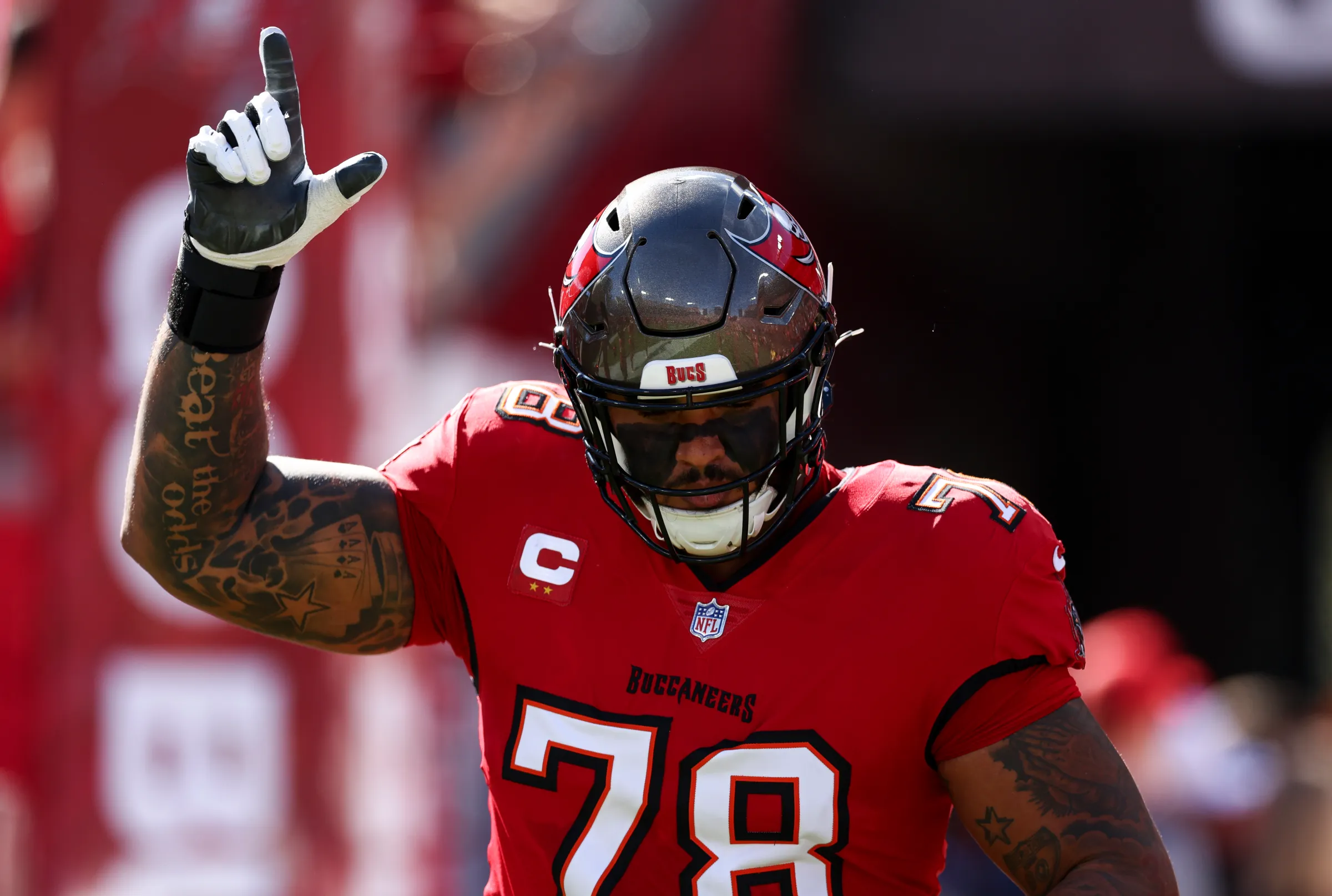
Tristan Wirfs is one of the best left tackles in the NFL, both as a pass protector and a run blocker. There really isn’t much to say about a player like Wirfs beyond the fact that he’s an elite talent and a massive asset to both this offensive line and the offense as a whole. Having a blindside protector of his caliber is what allows Baker Mayfield to play his aggressive style of football. It’s no coincidence that when Wirfs missed time last season, Baker’s play fell off a cliff.
On the opposite side is Luke Goedeke. He isn’t a superstar, but he’d be the best tackle, or even the best offensive lineman, on plenty of teams around the league. He’s a great complement to Wirfs, providing quality play in both the run and pass game to give Tampa Bay one of the league’s best tackle duos.
2024 first-round pick Graham Barton is Tampa Bay’s starting center after making the transition from tackle at Duke. He may not have fully lived up to his first-round billing yet, but he’s already established himself as a quality starter with plenty of room to improve as he continues learning the position. Even when he gets beaten, the mistakes are rarely catastrophic, giving the Buccaneers a high floor at center. 2023 second-round pick Cody Mauch initially struggled with play strength, but he’s added bulk and established himself as one of the better guards in the league, although injuries limited him last season. Like Barton, he’s still relatively new to his position after moving from left tackle in college to right guard in the NFL, so there’s still room for growth as he returns from injury. Ben Bredeson is probably the weakest starter on the line, but that’s a good problem to have. He’s a dependable pass protector who has refined his technique, even if he doesn’t offer much as an athletic run blocker.
Dan Feeney is probably the top depth option, providing veteran experience with the flexibility to play both guard and center. He wasn’t spectacular last season, but he knows his job and can fill in when needed. Free-agent addition Justin Skule was signed to be the swing tackle. He’s a solid run blocker for a backup, although pass protection remains a weakness. He’s perfectly adequate as a reserve but isn’t someone you’d want starting for an extended period. 2025 UDFA Benjamin Chukwuma was forced into action for 13% of the Buccaneers’ offensive snaps last season and held his own at tackle. He obviously isn’t pushing for a starting job, but as a fourth tackle, there’s plenty to like about his development. Billy Schrauth, a fifth-round pick this year, isn’t an elite athlete or overpowering blocker, but he’s a polished technician coming out of Notre Dame who feels like excellent depth and could eventually develop into a starter in the mold of Ben Bredeson.
Those nine players are probably the ones who make the roster, but 2024 sixth-round pick Elijah Klein is still around and will compete for a spot. The same goes for 2023 UDFA Luke Haggard, who has managed to stick around as valuable depth. The rest of the group includes 2025 UDFAs Marshall Foerner, Ben Scott, and Nash Hutmacher, along with 2026 UDFAs Henry Lutovsky and Paul Rubelt. Lutovsky is the most intriguing name to me, while Rubelt is currently Tampa Bay’s International Player Pathway Program participant, giving the Buccaneers the option of keeping him on the practice squad without using a standard roster spot.
Offense (18th) – Pass Game (19th) – Run Game (6th)
The offense is full of wild cards, but a dominant offensive line raises the floor of this unit considerably. If Baker Mayfield and the receiving corps can play to their potential, this offense has a chance to be one of the better groups in a relatively weak NFC South. If not, the Buccaneers will need to lean on their offensive line and hope the running game can carry more of the load. Either way, everything on this side of the ball starts up front.
Defensive Line (13th)
Interior Defensive Line (9th)

Vita Vea is the star of the interior. He’s inconsistent but he’s a huge run stuffer, with surprising pass rush prowess at his size as well. The contract dispute has led to him demanding a trade, which Tampa is really unprepared to do, so hopefully they work this out. He’s a nose tackle in the 3-4 system, but he’s a good enough rusher to play a traditional DT role in formations without a nose. In this system, they use 2 ends on opposite sides of Vea in base defense. 2023 1st rounder Calijah Kancey is the pass rusher of the group, he’s undersized and can slide out to edge at times. Unfortunately, the undersized athlete has not been able to stay healthy at all in the league, and it’s getting to the point where it seems silly to assume a healthy season from Kancey. A’Shawn Robinson isn’t nothing as a pass rusher, but he’s at his best as a run defender. He covers for Kancey’s huge deficiency in run defense. In formations with only 2 interior pieces, Vea and Robinson can play on early downs with Kancey coming in for Robinson on pass downs. But they’ll also all see the field together in 3-4 as well. Bain can also move inside and rotate as well, and there is some depth here too.
Elijah Roberts is a rotational pass rusher who can play the end. He was a 5th rounder last year and really fits this defense as a backup to Kancey if he gets hurt or someone who can rotate with Robinson on 3rd downs. Rakeem Nunez-Roches is a balanced veteran end as well who can fill in as depth. DeMonte Capehart is a 5th round rookie athletic defensive lineman. He’s listed at nose tackle and could rotate in at nose, but isn’t a full time option there and should really just be used to give Vea a break as a designated pass rusher. Elijah Simmons is the closest thing you have to a true Vita Vea replacement at Nose Tackle, and could end up starting for them if Vea gets traded, or even not make the team if he doesn’t. That’s a wide range of outcomes, but realistically Simmons is on the roster bubble and likely leaning out unless the Buccaneers decide they really need that skillset. I would probably run with Simmons over Nunez-Roches whose role seems more redundant, but that doesn’t seem to be where the Buccaneers are leaning at the moment. Jayson Jones is less proven but is also a Vita Vea replacement as a huge nose tackle who could enter the conversation if Vea gets traded. Finally, the Buccs added 3 UDFA’s at the position, Josiah Green, Deshawn McKnight, and Travis Shaw, but none of them were on my radar as draft prospects.
Edge Rushers (18th)

Rueben Bain Jr. was one of the highest-rated players in this draft on my board. A lot was made about his short arms throughout the pre-draft process, but his tape consistently showed a productive edge rusher who never let that limitation affect his play. I see a true No. 1 edge rusher who never should have fallen to the Buccaneers, especially in a weaker draft class. He’s exactly what this defense needed, and Tampa Bay deserves credit for taking him when he slipped to No. 15. He’s my pick for Defensive Rookie of the Year and has all the tools to break out immediately. At the very least, Bain is already a quality run defender, which is especially valuable if the Buccaneers end up moving on from Vita Vea. He also has the versatility to kick inside as a 3-technique or 4-technique defensive end in Tampa Bay’s 3-4 front.
2023 second-round pick YaYa Diaby burst onto the scene as a rookie and has settled in as a very good No. 2 edge rusher. He thrives as a cleanup pass rusher, finishing plays when the rest of the defensive line is generating pressure, something the Buccaneers haven’t always done consistently. He’s a better pass rusher than run defender, but he’s more than big enough to hold his own against the run and fill gaps when needed.
Anthony Nelson has quietly stuck around since being drafted in 2019. Early in his career, he was almost exclusively a run defender, but he’s developed enough as a pass rusher to provide value in both phases. He’s still at his best rotating in on early downs and isn’t someone you want playing every obvious passing situation, but he fills the third edge role very well. Tampa Bay also added Al-Quadin Muhammad from Detroit. He’s another veteran whose best football is probably behind him, but he’s still a dependable run defender with enough pass-rushing ability to contribute. His skill set overlaps quite a bit with Nelson’s, and together they can help keep the starters fresh throughout the season.
Next in the conversation is 2025 fourth-round pick David Walker. Walker slipped in the draft because he played at Central Arkansas and had some off-field concerns, but he suffered an injury just before last season and missed his entire rookie year. Before that injury, the coaching staff consistently praised him and seemed to have a clear role in mind as a designated pass rusher. Now that the depth chart is more crowded, 2026 feels more like a developmental season. If injuries strike, though, I’d expect Walker to rotate in on passing downs while Nelson or Muhammad handles the early-down work.
The Buccaneers also still have 2024 second-round pick Chris Braswell. After producing just 2.5 sacks through his first two seasons, his roster spot is beginning to look shaky. I still think he’s talented enough to earn a place somewhere in the league, but with him effectively sixth on the depth chart, it may be time for Tampa Bay to move on. That crowded edge room also makes it difficult for Mohamed Kamara and 2026 UDFAs Jack Pyburn and Yasir Holmes to stick around. I really liked Pyburn as an undrafted free agent after the draft and would love to see him stick around on the practice squad. Overall, it’s a great room that turns elite if Bain does develop into that number 1 rusher.
Linebackers (26th)

Franchise legend Lavonte David called it a career, leaving the Buccaneers with enormous shoes to fill, even if he was well past his prime by the end. Tampa Bay brought in three different pieces to help replace him, each offering a different skill set.
Alex Anzalone projects as the veteran leader of the group. He’s a steady, well-rounded linebacker who provides solid play in every phase while bringing a little extra juice against the run. He’s the type of LB1 who won’t elevate a defense by himself, but he’ll keep the unit stable and rarely be the reason things go wrong.
Second-round rookie Josiah Trotter is expected to start alongside him. Trotter is a physical linebacker who brings legitimate value as a blitzer. As a traditional off-ball linebacker, he’s much more of a run defender and tone-setter than a proven coverage player. There’s room for him to improve in coverage, but his lack of agility probably puts a ceiling on what he can become in that area. Even so, he has all the tools to be an impact starter because of what he brings against the run and as a pass rusher.
SirVocea Dennis has already been forced into action at times during his career and profiles similarly to Trotter. He’s a downhill run defender and effective blitzer, but his coverage ability never really developed. He has value as a rotational linebacker and can step into Trotter’s role if needed, but Buccaneers fans should be much more comfortable with him coming off the bench than playing every down.
Free-agent addition Christian Rozeboom projects as the primary backup to Anzalone. He’s a veteran communicator who can wear the green dot and offers a more balanced skill set than Dennis or Trotter, although he’s still more reliable against the run than he is in coverage. Rounding out the room are 2025 UDFAs Nick Jackson and John Bullock, along with 2026 UDFAs Javin Wright and Caden Fordham. They’ll likely spend training camp competing for the final roster spots and trying to carve out roles on special teams.
Cornerbacks (20th)

Zyon McCollum was one of my favorite prospects in the 2022 draft, and Tampa Bay landed a steal when he fell to the fifth round. He’s developed into a quality starting corner, although he’s still a volatile player from week to week. At his best, he’s an outstanding coverage defender, but he can disappear at times. Ideally, he’s a high-end CB2. Unfortunately, with Jamel Dean gone, he’ll likely be asked to match up with opposing WR1s on a regular basis.
2025 third-round pick Jacob Parrish put together a solid rookie season. He’s a well-rounded corner with the versatility to play both inside and outside, while also providing quality run support. There’s a real chance he develops into Tampa Bay’s top corner if he proves to be the more consistent coverage defender. He’ll likely open the season as the starting slot corner but should kick outside whenever the Buccaneers are in their base defense.
2025 second-round pick Benjamin Morrison, who was actually drafted before Parrish, had a much rockier rookie campaign. He struggled throughout the season and didn’t show many flashes of why he was selected so early. He’s strictly a boundary corner, doesn’t offer much as a run defender, and honestly doesn’t feel like a natural fit for Todd Bowles’ defensive scheme.
Fourth-round rookie Keionte Scott is the other player in the mix for a starting role, although he’s really more of a safety than a traditional cornerback. His best fit is in the slot, where his physicality and run defense align perfectly with what Bowles typically wants from his nickel corner. If the Buccaneers are comfortable moving Parrish to the boundary full time, Scott has a legitimate chance to win the starting slot job as a rookie.
If Scott instead settles in as a backup safety and Morrison remains the outside starter, the Buccaneers will have to look a bit deeper for cornerback depth. 2023 sixth-round pick Josh Hayes was a major special teams contributor last season but didn’t log a single defensive snap. Chase Lucas is currently on the PUP after being brought in to provide veteran depth. Damarion Williams is another athletic depth option who still hasn’t developed into a reliable contributor. Kemon Hall is an experienced special teamer but faces an uphill battle to make the roster. Finally, 2026 UDFA Ayden Garnes has generated some positive buzz during training camp, but he still feels like a long shot to make a roster that could use more proven depth at cornerback.
Safeties (4th)

This is one of the best safety duos in the league, and both players are ideal fits for Todd Bowles’ defense. Antoine Winfield Jr., a 2020 second-round pick, is one of the NFL’s premier safeties, particularly because of what he brings against the run. He’s not a flawless coverage defender, but he’s an outstanding athlete with strong instincts in coverage, and when you pair that with his elite run defense, you get one of the league’s most complete safeties.
Tykee Smith, a 2024 third-round pick, has developed into a very similar type of player. Originally deployed as a slot corner in this defense, Smith has emerged as another excellent run defender with the athleticism to continue improving in coverage. Together, Winfield and Smith provide elite run support with more than enough coverage ability to rank among the NFL’s best safety tandems.
The concern is the depth behind them. Miles Killebrew was signed away from Pittsburgh this offseason, but he’s made his career primarily as a special teamer. Ifeatu Melifonwu is another veteran addition who has experience at safety, outside corner, and slot corner, although he’s far from a roster lock. Fourth-round rookie Keionte Scott is probably the most intriguing backup option, even if he wins the starting nickel job. If one of the starting safeties were to miss time, Scott would likely be the first player I’d consider moving into the lineup.
Beyond that, the room is filled with developmental and special teams players. Rashad Wisdom, a 2024 UDFA, made the roster last season and appears to be well-liked by the coaching staff, although he hasn’t shown much defensively yet. 2025 UDFA JJ Roberts has generated some positive buzz during training camp and could earn a roster spot as a depth safety and special teams contributor. Rounding out the group is 2024 UDFA Marcus Banks, who will compete with Roberts and Wisdom for one of the final spots.
Defense (15th) – Front Seven (16th) – Coverage Unit (13th)
The defense grades out as pretty average for me overall. I do think the run defense has a chance to be a real strength, but the uncertainty surrounding Vita Vea makes even that projection difficult. If Vea is traded or decides to hold out without Tampa Bay bringing in another impact defensive lineman, both the defense and the team as a whole would drop a few spots in what is a very tightly packed tier of teams.
There are also some depth concerns throughout the roster, most notably at safety. The starting talent is excellent, but the drop-off behind Antoine Winfield Jr. and Tykee Smith is significant. If the Buccaneers avoid the injury bug, this defense should be solid enough to complement the offense. If injuries start to pile up, though, the lack of proven depth at several positions could become a real problem.
Specialists (9th)

There are no major changes among the key specialists. Chase McLaughlin returns as one of the league’s better young kickers and is a legitimate strength of this unit. Riley Dixon, on the other hand, struggled through an underwhelming 2025 season and currently ranks closer to the bottom tier of NFL punters. Evan Deckers is one of the younger long snappers in the league and has held the job since entering the NFL as an undrafted free agent in 2023. Veteran Scott Daly was brought in to compete with Deckers, but I expect Deckers to win that battle and keep the job. The Buccaneers also have B.T. Potter in camp, but barring an injury, this is clearly McLaughlin’s job.
In the return game, Kameron Johnson is expected to handle punt return duties after showing encouraging signs as a young return specialist. The current depth chart lists Kenny Gainwell and Sean Tucker ahead of him on kick returns, however, while Tez Johnson is another player who could factor into the return game.
The coverage units were the real problem last season, playing well below expectations and ultimately contributing to the firing of Thomas McGaughey. Danny Smith was brought in to fix those issues, and I think he’ll have a significant impact. Tampa Bay has also turned over a number of the back end of the roster with special teams in mind, giving this unit a good chance to take a meaningful step forward in 2026.
Win Prediction (Over 8.5)
The Buccaneers play in a weak division, and their strength in the trenches gives them a high floor that should allow them to consistently take care of inferior opponents. That said, the schedule isn’t especially forgiving. They have to face the deep NFC North, including road trips to both Chicago and Detroit, and outside of the division, the only truly favorable matchup is when the Browns come to town, unless you count the Steelers as well.
Even with a tougher-than-expected schedule, I think this team is better than an 8.5-win roster. Their floor is high enough to avoid a collapse, and if the offense gets solid quarterback play and the defense stays healthy, I think they’ll clear 8.5 wins without much trouble and ultimately win the NFC South.